

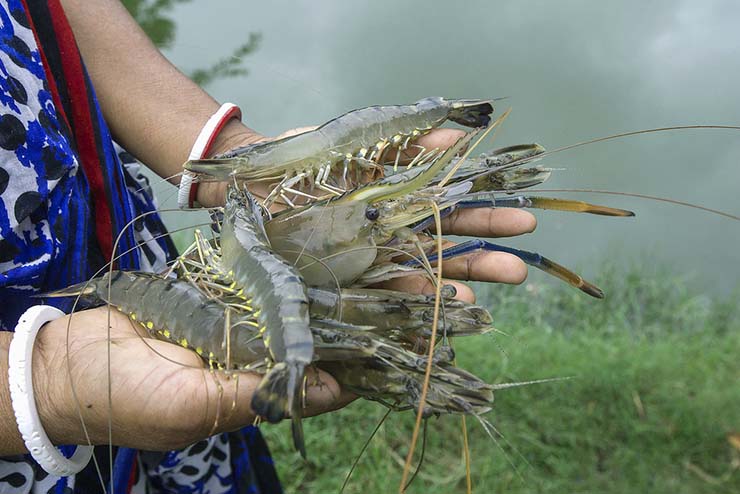

In traditional shrimp farming across Bangladesh, disinfectants have become a reflex — not a strategy.
The moment something looks wrong in the pond, farmers reach for a chemical. Most are following neighbors or local suppliers, not science. The goal seems straightforward: kill the bad stuff. But disinfectants don’t read labels. They wipe out everything — including the microbial life that keeps a pond alive.
Beneficial bacteria (like Nitrosomonas, Nitrobacter etc.) are the invisible engine of a healthy pond. They break down ammonia through nitrification — quietly, continuously, for free. Knock them out, and the system unravels fast.
Without these bacteria, ammonia climbs. Uneaten feed, shrimp waste, and dead algae pile up at the bottom. In traditional ponds — where water exchange is already limited and monitoring is minimal — the damage compounds quickly. Oxygen drops. Toxic gases like ammonia, hydrogen sulfide, and methane build up. Shrimp get stressed, their immunity weakens, and the conditions become a perfect breeding ground for the very pathogens farmers were trying to destroy.
The cruel irony? The solution becomes the problem. Farmers apply more disinfectants to fight more disease — spending more money while the pond degrades further. It’s a cycle that’s hard to see when you’re inside it.
There is a better way.
Prebiotic and probiotic-based farming works with nature, not against it. Prebiotics feed and strengthen the beneficial microbial communities already present in the pond. Probiotics introduce targeted good bacteria that outcompete pathogens, stabilize water quality, and accelerate the breakdown of organic waste. Together, they rebuild the biological engine that disinfectants keep destroying.
The results are tangible. Farmers who shift to this approach spend significantly less on chemicals — often cutting input costs by a third or more. Shrimp grow in cleaner, more stable water. Survival rates improve. Disease outbreaks become less frequent and less severe. A better crop, at lower cost, with less risk.
Scale this across thousands of farms along Bangladesh’s coast, and the impact goes far beyond any single pond. Healthier shrimp production means more reliable export volumes, stronger income for farming households, and less economic shock from disease-driven crop failures — which have historically wiped out entire seasons and pushed families deeper into debt.
Shrimp is one of Bangladesh’s most valuable export commodities. But its potential is being quietly undermined by a farming culture built on chemical dependency. Fixing that isn’t just good for farmers — it’s good for the entire value chain, from hatchery to international buyer.
At FISHBYTE, we’re working to change this. Bangladesh’s coastal farmers are already living on the edge — economically and environmentally. This disinfectant cycle is a weight they can’t afford to carry.
We believe resilience has to come from within the pond, not from a chemical bottle. Nature-based, science-backed farming isn’t a luxury. For these farmers, it’s a lifeline.